
Quantem Innovations
SEEBIC Altura Holder
SEEBIC Altura Holder
Quantem Innovations introduces the SEEBIC Altura Holder: a practical add-on for bringing secondary-electron electron beam-induced current imaging into STEM/TEM. The holder provides fast, surface-sensitive information from nanomaterials without modifying the microscope column or disrupting standard imaging and analytical modes. Developed from research at EMAT, University of Antwerp, SEEBIC Altura is designed to make advanced nanoscale surface characterization more accessible for academic and industrial laboratories.
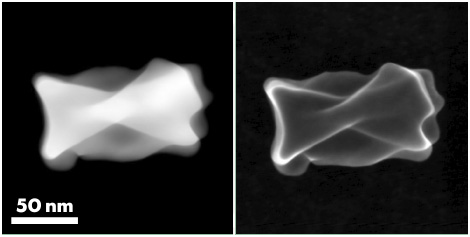
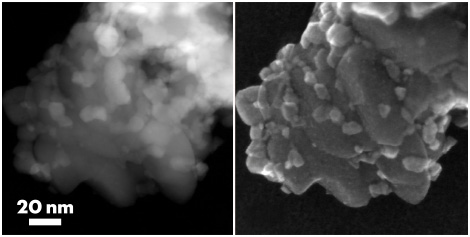
Image courtesy of B. Weckhuysen, Utrecht University
View example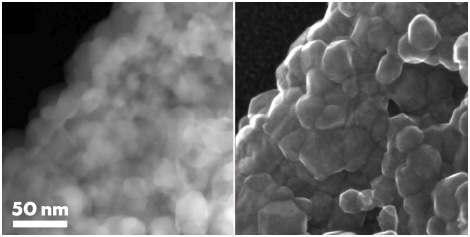
Understanding nanomaterials often requires more than a 2D projection. Surface morphology, particle overlap, aggregation and local shape can strongly influence material performance, yet high-throughput 3D characterization at TEM-relevant resolution remains difficult in routine workflows.
SEEBIC Altura adds secondary-electron-based contrast directly through the TEM holder. It provides live, surface-sensitive imaging in STEM/TEM without column modifications and without the time, complexity and reconstruction burden of full electron tomography.
The result is a low-barrier upgrade for existing instruments: faster screening, clearer surface information and larger particle statistics for R&D, process optimization, quality control and regulatory characterization.
SEEBIC is relevant wherever nanoscale surface structure matters and conventional 2D TEM or SEM leaves too much ambiguity. Key application areas include:
Optically active nanocrystals: surface morphology can strongly affect optical response, chirality and function. SEEBIC Altura enables faster, higher-resolution screening of particle shape and surface features directly in STEM/TEM.
Catalyst nanoparticles: activity, selectivity and stability often depend on whether particles are on, in or partly embedded in a support. SEEBIC provides a practical route to surface-sensitive imaging of small particles on complex or thick supports, reducing reliance on slow correlative workflows and tomography.
Regulatory particle analysis: reliable size and shape assessment requires more than a single 2D projection. SEEBIC can help distinguish morphology, overlap and aggregation state, supporting faster and more robust nanomaterial characterization.
SEEBIC measures the current created when secondary electrons leave the sample during scanning. The primary electron beam generates secondary electrons; when they escape, replacement charge flows through the sample. That current is detected, amplified and converted pixel-by-pixel into an image that highlights surface and structural information.
Selected publications behind the SEEBIC Altura technology, listed chronologically.
Evgenii Vlasov, Alexander Skorikov, Ana Sánchez-Iglesias, Luis M. Liz-Marzán, Johan Verbeeck, Sara Bals
ACS Materials Letters 5 (2023), 1916–1921Evgenii Vlasov, Wouter Heyvaert, Bing Ni, Kyle Van Gordon, Robin Girod, Johan Verbeeck, Luis M. Liz-Marzán, Sara Bals
ACS Nano 18 (2024), 12010–12019Evgenii Vlasov
PhD thesis, University of Antwerp, 2024Evgenii Vlasov, Wouter Heyvaert, Tom Stoops, Sandra Van Aert, Johan Verbeeck, Sara Bals
Ultramicroscopy 280 (2026), 114278